
What’s the Minimum Order for Custom Printed Notepads?
If you landed here, you probably want a number, so I’ll give you one right away: at Captain Notepad, you can order custom printed notepads in quantities as small as 8 or 9 pads, depending on the size. That’s it. No “minimum 100.” No “minimum 250.” A handful of pads is a perfectly real order, and we run them every week.
I’ve been printing custom notepads for 25 years, and I want to give you the honest, behind-the-scenes version of how minimums actually work — why they exist, what they cost you, and when it makes sense to order small versus going bigger. This is the stuff most “minimum order” articles skip.
The Short Answer, by Size
Here are the starting quantities for our most popular notepad sizes:
- 4″ x 6″: minimum 9 pads
- 4.25″ x 5.5″: minimum 8 pads
- 5.5″ x 8.5″: minimum 8 pads
- 8.5″ x 11″: minimum 8 pads
That’s genuinely low for this industry. A lot of custom printers won’t touch an order under 50, 100, or even 250 pads, because small runs are inconvenient for them. We built our shop to handle them.
Why the Minimum Isn’t a Single Number
The minimum changes with the size, and the reason comes down to one thing most buyers never think about: how many pads we can fit on a printing sheet.
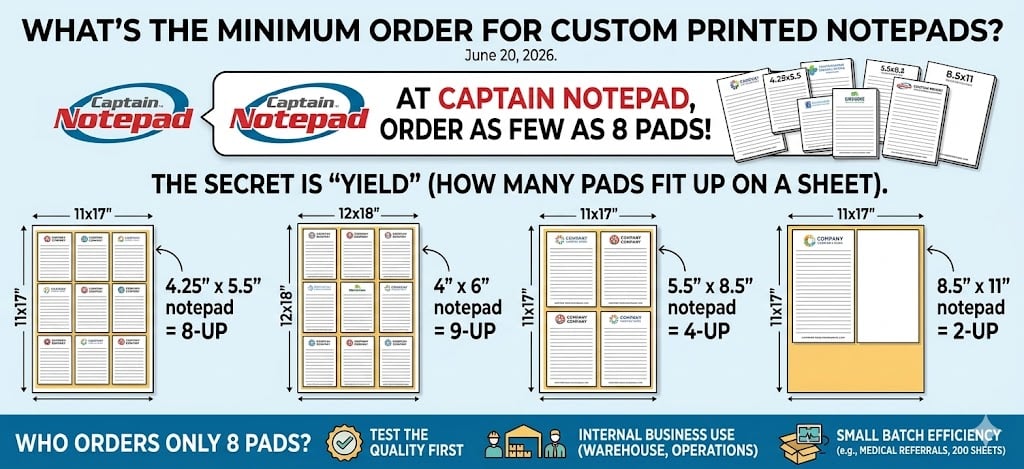
We print primarily on two parent sheet sizes — 11″ x 17″ and 12″ x 18″ — and then cut the printed sheets down into individual pads. How many pads we get out of one sheet is called the “yield,” or how many are “up” on a sheet. Here’s how our common sizes lay out:
- A 4″ x 6″ pad is 9-up on a 12″ x 18″ sheet.
- A 4.25″ x 5.5″ pad is 8-up on an 11″ x 17″ sheet.
- A 5.5″ x 8.5″ pad is 4-up on an 11″ x 17″ sheet.
- An 8.5″ x 11″ pad is 2-up on an 11″ x 17″ sheet.
The bigger the pad, the fewer fit on a sheet, which is why the press setup, paper, and labor behind even a tiny order add up differently for each size. The yield is the engine behind every minimum we quote. Once you understand it, the whole pricing structure of custom printing starts to make sense.
Who Actually Orders Just 8 Pads, and Why
A low minimum isn’t a gimmick. Over the years I’ve seen three very practical reasons people order small, and each one is completely legitimate.
They Want to Test the Quality First
Smart buyers order a small batch first to see the real thing in their hands — the sharpness of the printing, how clean and strong the padding glue is, and the sturdiness of the chipboard backer. You can’t judge a notepad from a screen. Ordering 8 pads to vet a vendor before placing a big order is one of the wisest things a buyer can do, and I respect it every time.
They Use the Pads Internally
Plenty of orders never get handed to a customer at all. Businesses use custom pads for tracking inventory, warehouse notes, and other internal operations. They don’t need hundreds, they need a working supply, and a small run is exactly right.
The Math Already Works in Their Favor
Medical offices are a great example. A typical order of just 8 pads of 5.5″ x 8.5″ referral notepads, at 25 sheets per pad, gives you 200 individual sheets. For a lot of practices, that’s several months of referrals. Why order 500 pads of something you’ll work through slowly when 8 covers you comfortably?
The Honest Trade-Off: Small Orders Cost More Per Pad
Here’s the part I won’t sugarcoat, because you deserve a straight answer.
Small quantities are more expensive per unit. That’s not a markup gimmick, it’s labor. The setup, press time, cutting, and padding take roughly the same hands-on effort whether you’re making 8 pads or 800, so when you spread that labor across only 8 pads, the per-pad cost is higher.
But “more per pad” doesn’t mean “a bad deal.” Look at the alternative. If you order hundreds of pads you won’t go through for years, you’ve sunk hundreds of dollars into inventory that just sits there, and by the time you finally use it, your phone number, address, logo, or offer might be outdated, and now you’re throwing pads away. A small order means you only buy what you’ll actually use, while it’s still current. For a lot of buyers, that’s the smarter spend even at a higher unit price.
When you do need volume, you’re rewarded for it: order more and the per-pad price drops meaningfully. The trick is matching the quantity to your real-world usage, not to whatever number sounds impressive.
When It Makes Sense to Size Up
Let me give you an example that shows the whole arc.
Say a real estate agent orders 100 pads to start — modest, affordable, low-risk — and hands them out to the neighbors around a listing. Notepads are sticky in the best way: people keep them by the phone, on the fridge, on the desk, and they see that agent’s name every single day for months.
Now suppose one of those dollar-or-so notepads generates a single lead, and that lead becomes a closed sale. One real estate commission can be several thousand dollars. Suddenly that agent has both the proof that notepads work and the budget to scale, and the next order isn’t 100 pads, it’s a mass direct-marketing run at a much better per-pad price.
That’s the right way to think about sizing up: let a small, affordable order prove the channel, then reinvest the return into volume. You don’t have to bet big on day one.
The Myth I’d Like to Bust
The biggest misconception I run into is that a low minimum signals a low-quality or “small-time” printer, that real custom work requires committing to hundreds of pads. It’s the opposite. A shop willing to run 8 pads well is a shop that has its production dialed in tightly enough to make small runs work. The minimum reflects how a printer is set up, not the quality of what comes out the door.
Bottom Line
The minimum order for custom printed notepads should never be the thing that stops you. At Captain Notepad you can start with as few as 8 or 9 pads — enough to test our quality, cover an internal need, or launch a small marketing experiment without tying up your cash. Order small to prove it works, then scale into volume pricing when the demand is real.
If you’re not sure which size or quantity fits your goal, that’s exactly the kind of question we like to answer. Reach out and we’ll help you start at the right number.
Frequently Asked Questions
What is the minimum order for custom printed notepads?
At Captain Notepad, the minimum is as low as 8 or 9 pads, depending on the size. A 4″ x 6″ pad starts at 9, while 4.25″ x 5.5″, 5.5″ x 8.5″, and 8.5″ x 11″ pads each start at 8. That’s well below the 50-to-250-pad minimums many printers require.
Why does the minimum change depending on the notepad size?
It comes down to how many pads fit on a printing sheet. We print on 11″ x 17″ and 12″ x 18″ sheets, then cut them into pads. A small 4″ x 6″ pad is 9-up on a sheet, while a large 8.5″ x 11″ pad is only 2-up. The yield per sheet sets the practical minimum for each size.
Why do smaller notepad orders cost more per pad?
Labor. The setup, press time, cutting, and padding take roughly the same effort whether you’re making 8 pads or 800. When that work is spread across only a handful of pads, the per-pad cost is higher. Order in volume and the price per pad drops.
Can I order a small batch to test quality before a large order?
Absolutely, and it’s one of the smartest things a buyer can do. A small order lets you check the print sharpness, the strength of the padding glue, and the sturdiness of the chipboard backer in person before committing to a big run. You can’t judge a notepad from a screen.
Does a low minimum mean lower print quality?
No, it’s the opposite. A shop that can run 8 pads well is one with its production process dialed in tightly enough to make small runs work. The minimum reflects how a printer is set up, not the quality of the finished pad.
When should I order a larger quantity?
Size up once you have proof the pads are working and a real need for the volume. A common path: order a modest batch to test the response, and when those pads start generating leads or sales, reinvest into a larger run that earns a better per-pad price. Match the quantity to your actual usage rather than to an impressive-sounding number.
