Most small businesses buy printed giveaways on gut instinct. The pens look nice, the stickers are cheap, the notepads feel professional, then the items vanish into a junk drawer, and the promo budget disappears with them. If you’ve ever wondered what printed giveaways have the best ROI for small business advertising, the answer starts with data, not instinct. After 25+ years of manufacturing branded print products from our Denver facility, we’ve watched what recipients actually keep, use, and associate with the brands that gave them. The metrics don’t lie. This guide ranks the most common printed promotional products by cost-per-impression, retention rate, and brand recall, so you can stop guessing and start spending with a clear return in mind.
The Three ROI Metrics Worth Measuring Before You Spend a Dollar
Before comparing products, you need a shared framework. Three numbers do most of the work: cost-per-impression (CPI), retention rate, and brand recall. Each tells you something different, and all three together tell you whether a printed giveaway is actually earning its place in your small business advertising budget.
Cost-per-impression (CPI): your true cost per eyeball
CPI is straightforward: take the unit cost of an item and divide it by the estimated total impressions it generates over its useful life. A $0.50 pen that generates 2,000 impressions costs roughly 1/10th of a cent per impression, far cheaper than virtually any digital ad placement you can buy. The catch is that CPI only tells part of the story. High impressions mean nothing if the item doesn’t trigger brand recognition when someone actually needs your product or service.
Retention rate: how long recipients actually hold on to the item
Retention rate measures how long someone keeps a promotional item before discarding it. According to the Advertising Specialty Institute (ASI), 58% of people keep a promotional pen for over a year, and the pattern holds across functional items generally. Longer retention equals more passive brand impressions at zero additional cost. Decorative items with no utility drop out of this race quickly, while functional items like pens, notepads, and magnets hold on.
Brand recall: does the item make people remember you?
According to PPAI research, 83% of recipients remember the brand on a promotional item, and 79% say they’re more likely to do business with that brand in the future. Those are remarkably strong numbers compared to banner ads or social posts. High-visibility placement drives the effect: an item sitting on a desk or stuck to a fridge generates stronger brand memory than something buried at the bottom of a conference tote. This is where notepads and magnets consistently outperform pens on pure recall metrics.
What Printed Giveaways Have the Best ROI for Small Business Advertising?
Here’s how five common printed giveaway categories stack up when you evaluate them against all three metrics honestly, not just the price tag on the quote sheet. Understanding which custom printed giveaways deliver the best ROI for small business advertising means looking beyond unit cost to retention, recall, and daily use.
Pens: unbeatable CPI, but weaker on brand recall
Pens are the volume play. Unit costs run $0.50 to $2.00 at standard quantities, dropping to around $0.20 per pen on bulk orders. With an estimated 2,000+ impressions per pen over its lifespan, the CPI calculation is almost embarrassingly favorable. The catch: pens are mentally co-branded with whoever hands them out in the moment, not just with the logo on the barrel. They work best in high-traffic situations where volume matters, trade show booths, front desks, event check-in tables, where sheer quantity drives consistent distribution.
Stickers: low cost, long life if you choose vinyl
Stickers cost under $1 each at standard quantities and drop to pennies per piece at volume. The critical variable is material: premium vinyl stickers last three to five years outdoors, while cheaper paper stickers fade within weeks. Placement drives the impression math. A sticker on a laptop lid, water bottle, or car bumper generates passive impressions for years at near-zero ongoing cost. Minimum order quantities typically start at 25 to 50 units, making stickers one of the easiest entry points for testing a new printed giveaway without a large upfront commitment.
Postcards: trackable, direct, and measurable
Postcards run $10 to $20 per 100 units, making them affordable for direct mail campaigns with a defined geographic target. Unlike most printed promotional products, postcards support direct tracking through QR codes and promo codes, giving you real conversion data rather than estimated impressions. Retention is short, most postcards get one to three views before heading to the recycling bin. But when the offer is strong and the call to action is clear, that short window can drive measurable response, especially for realtors, healthcare offices, and local service businesses with a specific service area. If you want examples and category ideas, check our custom postcards products and industry roundups that list postcards among top promotional items for small businesses.
Notepads and magnets: the retention and recall leaders
Both items share the same core advantage: they earn daily placement in high-visibility spots and stay there for months or years at no additional cost. A notepad on a recipient’s desk generates an impression every time they reach for it. A fridge magnet generates an estimated 20 or more impressions per day in an active household, compounding into thousands of brand touchpoints over the course of a year. A study of nonprofit fundraising campaigns found that personalized notebooks contributed to a 20% increase in donor retention, reinforcing what the daily-use logic already suggests. When an item is genuinely useful, it builds loyalty and memory simultaneously. On both retention rate and brand recall, these two categories consistently finish at the top of the printed giveaway ROI rankings for small businesses.
Why Notepads and Magnets Earn the Top Spot for Daily Brand Exposure
The desk and fridge placement effect is not subtle. When a branded item lives in someone’s workspace or kitchen for six months, it generates repeated passive impressions without any additional spend on your end. No clicks to bid on, no algorithm to appease. Once the initial distribution cost is paid, the item keeps working, and that bridge to your next budget decision matters: low minimum order quantities make it practical to test these items without overcommitting.
Most promotional product distributors require large minimum orders before their pricing makes economic sense, which forces small businesses to commit to 500 units of an untested item before they know whether it performs. Captain Notepad manufactures directly in Denver, Colorado, with no middleman markup and low minimum order quantities. That means you can test custom notepads and magnets at a scale that fits a real small business budget rather than a national franchise’s quarterly promo plan. Browse our full selection of custom marketing materials to see what fits your test budget.
Factory-direct ordering eliminates distributor margins, which typically add 30 to 50% to the unit cost shown in a third-party catalog. A lower unit cost directly improves your CPI calculation. Captain Notepad’s online design tool and free design assistance also reduce soft costs, the time, back-and-forth emails, and setup fees that quietly inflate the total cost of a small promo run, keeping your printed giveaway ROI as strong as possible from the first order.
Matching Your Giveaway Mix to Your Budget and Audience
The goal isn’t to order everything at once. Pick two or three items that match your actual budget and audience, run them simultaneously, and collect comparison data within 60 to 90 days. Here’s how to think about allocation by budget tier.
Budget-tier breakdown: what to test at $150, $300, and $500
- Under $150: Start with stickers and pens. High volume, low risk, and they test your ability to distribute consistently before you invest in higher-retention items.
- $150 to $300: Add a small notepad run. Even a low-minimum order of branded notepads gives you a functional item with significantly higher retention potential than pens alone, and the per-unit cost stays manageable.
- $300 to $500+: Layer in magnets or postcards depending on your distribution channel. Magnets work well for door-to-door or in-office placement; postcards work best for direct mail campaigns with trackable calls to action.
Audience-specific picks that actually make sense
The right product depends as much on who receives it as on what it costs. Realtors get the most mileage from branded notepads and postcards: notepads stay in the home environment where daily use reinforces the brand, while postcards reach prospects directly in their mailbox. Healthcare offices are a natural fit for custom notepads and pens at the front desk, patients interact with both during every visit, which builds consistent brand associations in a professional setting. Local retail and service businesses benefit most from stickers and magnets: affordable, visible, and placed where customers see them every day. And for schools or sports organizations? Stickers and notepads deliver strong engagement with students and parents at a price point that works for tight activity budgets.
How to Measure Printed Giveaway ROI for Small Business Advertising
Tracking ROI from printed giveaways requires setup work before you distribute a single item. Without it, you’re back to gut instinct and hope. The tools below are free or nearly free, and they connect your offline distribution to measurable online or in-store actions.
Setting up tracking before you distribute
QR codes are the easiest starting point. Link each item’s QR code to a campaign-specific landing page and track scans, visits, and conversions through Google Analytics or a free tool like QR Code Generator Pro. Add UTM parameters to the URLs behind your QR codes using Google’s URL Builder or Bitly, so you can see exactly which printed giveaway drives the most web traffic at the campaign level.
Pair QR codes with unique promo codes printed on each product type, “PAD20” on notepads, “MAG20” on magnets, and track redemptions directly in your point-of-sale system or CRM. That gives you clean attribution data showing which item drove which revenue. The ROI formula is straightforward: subtract the campaign cost from the revenue it generated, divide by the campaign cost, and multiply by 100.
The 30-90 day test window: what to measure and when
In the first two weeks, distribute your items and confirm that QR codes and promo codes are live and tracking correctly. At the 30-day mark, pull your first data cut: how many scans, code redemptions, or web visits did each item type generate? At 60 to 90 days, calculate the CPI and conversion rate for each item and compare against your baseline. Items that generate consistent impressions and at least some measurable response earn a larger budget allocation in round two. Items that generate no measurable response get cut or redesigned before the next run. The data tells you where to focus.
The Bottom Line on Printed Giveaway ROI for Small Businesses
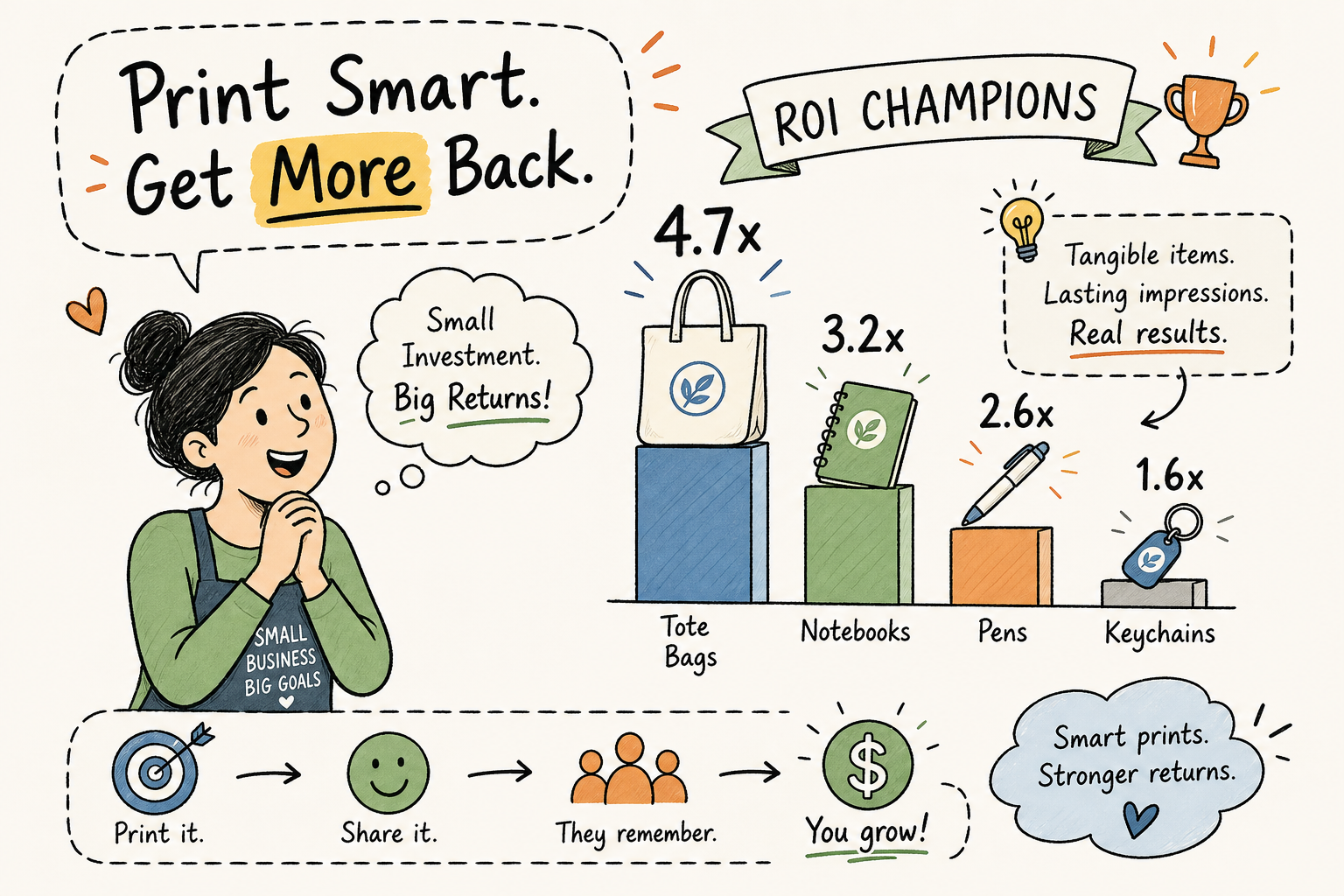
Small businesses don’t have unlimited promo budgets, so every dollar needs to earn its place. When you look at the full picture, retention rate, brand recall, and cost-per-impression together, notepads and magnets consistently deliver the best ROI for small business advertising among printed giveaways. Pens and stickers remain smart low-cost volume plays when distribution scale matters more than long-term placement.
Pick two or three items that match your budget and your audience, set up simple tracking before you distribute, and run a 30 to 90 day test. The results will tell you exactly where to focus next. If you want to start with USA-manufactured items, low minimums, and no middleman markup, Captain Notepad makes it easy to order custom notepads, magnets, stickers, and more directly from our Denver facility. Start small, test smart, and let the numbers drive your next order.
